Thursday, August 20, 2015

LSU Tigers star Ben Simmons: ‘I definitely want to be the No 1 pick'

From slumber parties to the heights of global basketball, Dante Exum and Ben Simmons have shared quite the journey since meeting over a decade ago. Once regulars on the courts of Melbourne, the Australian duo are now excelling in the US: the former a rising talent with the Utah Jazz (notwithstanding recent injury misfortune), the latter a college player widely tipped to be the No 1 draft pick in 2016. Despite busy schedules and the distance between them, they remain close friends.
Ben Simmons has been settling into Baton Rouge life. Photograph: Kelly Kline/Getty Images
“I usually call Dante every month,” recent Louisiana State University addition Simmons says following a training session. “We met when I was seven and have been really good mates ever since. We grew up together: training, having sleepovers, playing on the same team.”

The pair share many similarities. Both were born in Melbourne to American fathers whose pursuit of the basketball dream led them to Australia, where they became team-mates at the Melbourne Tigers. Exum and Simmons both spent time at the Australian Institute of Sport, a national basketball academy, while each possesses a not dissimilar mix of envious physical attributes.

There is, though, one stark difference: Simmons will never be an ‘international man of mystery’. Unlike his friend, a largely unknown quantity when he was drafted at No 5 in 2014, Simmons will have been scrutinised from every angle by the time he nominates for the NBA.

At present, these assessments points to one thing: Simmons being the most sought after player at the draft’s 2016 edition.

The 19-year-old’s rare combination of size, speed and ball-handling has scouts salivating, and a quick look at the innumerable highlight compilations on YouTube provide ample justification. Despite standing at 6ft 10in, Simmons is as confident running the floor or leading transition play as he is finishing under the basket – Sports Illustrated aptly described him as a “point center”.

The list of accolades earned by Simmons is similarly impressive: in 2015 he was Gatorade National Player of the Year, Naismith Prep Player of the Year and starred in the McDonald’s All-American game. With past Naismith winners including LeBron James and Kevin Love, Simmons is already in rarefied company.

But the path from high school awards to NBA success is littered with pitfalls, and Simmons is aware of the challenges ahead. While he defiantly declares: “I definitely want to be the No 1 pick – I’m always going to back myself over someone else,” he quickly acknowledges that “there is lots of work to do and much more pressure to come.”

Pressure – whether from the team, media, fans, or within – is a difficult beast. Chatting to the Guardian not long after being drafted, Simmons’ friend Exum looked slightly jaded, and spoke candidly about the intense media spotlight. Although Simmons has had a longer adjustment period, thanks to his decision to play on the American school circuit rather than remain at the less-visible Australian Institute of Sport, he admits to having mixed feelings about dealing with the hype.

“It gets easier day-by-day, but it becomes harder long term: the better you get, the more attention that is focused on you,” Simmons observes. “I’m fine with it, though: it’s all part of the experience.”

One factor keeping Simmons firmly rooted is his strong family network. As the youngest of six children and with an ex-professional providing fatherly guidance, Simmons has an effective barrier against an over-inflated ego. His godfather and now assistant coach at LSU, David Patrick, joked recently that “at home, he’s ranked nothing,” and Simmons shares this sentiment.

“I’m just Ben at the end of the day,” he laughs. “My family have always been there to support me – they have never put me on a pedestal and said I was this or that. Whenever I’m with them, I’m back to being the youngest in the family.”

Simmons also enjoys the support of a broader network at LSU, including alumnus Shaquille O’Neal. The four-time NBA champion described the college’s new recruit as “the best player in the world”, and even had time to pass on his best wishes via telephone.

“I spoke with him for a few minutes on the day I signed,” explains Simmons. “He just said congratulations and welcomed me to the family. It is awesome to know that he’s always there for me to ask questions.”

Having now officially joined LSU – almost nine months after he put pen to paper and took O’Neal’s call – Simmons has been busy settling into Baton Rouge life. In between summer school: “I have been taking kinesiology [the study of human movement], but I would like to major in sports management”, a controversial new marketing campaign and training sessions, Simmons has been preparing his colleagues for their pre-season visit to Australia (they departed last week).

“The team is looking great: we are still building up chemistry, but by the time we leave we will be ready to play,” he says. “I have been telling my team-mates about Australia every day! I haven’t been back in a year, so am really excited.”

Simmons does not, however, harbor particularly fond memories of his last trip home. After training with Australia’s national team before the Fiba World Cup, he was a surprise omission from the final Boomers squad. Asked whether he put this disappointment to good effect, Simmons responds bluntly.

“I did not really use it as motivation because I felt like I should have been on the team – I didn’t have any doubts about it,” he declares. “I walked away knowing that I was definitely a good player, but I had to focus on my next step. I just kept playing and working on my game.”

Despite this sour experience, Simmons retains a desire to play for the national team, perhaps as early as next year in Rio de Janeiro. With an exciting mix of young talent and a collection of experienced NBA regulars, the Boomers could mount a serious challenge to perennial favourites USA.

“Playing at the Olympics has always been a dream of mine,” Simmons admits. “But as soon as college finishes I might be focusing on the draft, or if not another season at LSU – so I have to take it one day at a time. But I would definitely go to the Olympics if I was healthy and fresh enough to perform.”

If Simmons is available and selected, one likely team-mate in Brazil will be the Cleveland Cavaliers’ Matthew Dellavedova. The pair trained together during last year’s pre-World Cup camp, before Dellavedova had burst into the collective consciousness, and Simmons speaks glowingly of Australian basketball’s man of the moment.

“It is always good to train with someone of his calibre,” he notes. “It has been great to see him succeed and compete with the top players. For him to get to the level and do really well is just awesome.”

Rewind a further year to 2013, and Dellavedova was without a club after going undrafted, Exum was still at school, and the hype surrounding Simmons had only just begun to surface. In a small arena in Canberra, all three shared the floor in a game against New Zealand, only days following Exum and Simmons’ national team debut. That fixture may have seemed inconsequential at the time, but it represented a major step as the duo sought to fulfil a shared basketball dream.

As kids, Exum and Simmons would often discuss their aspirations of playing professionally. Yet even these two self-assured and confident young men could not possibly have predicted the progress each would make towards basketball stardom.

“We have always talked about playing in the NBA, and now I just have to do my part,” says Simmons. “Playing against Dante – or with him – would be amazing.”

Wednesday, July 15, 2015

Reports: LeBron James signs two-year contract with Cleveland Cavaliers

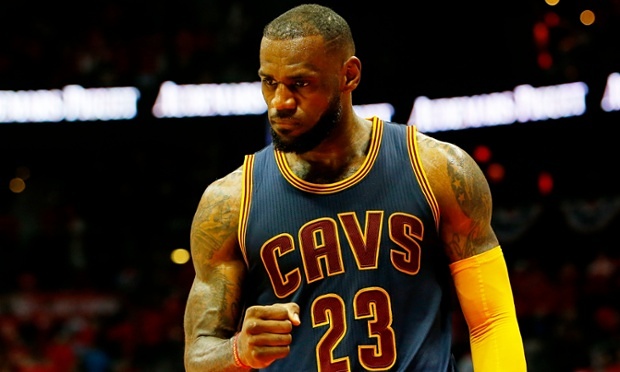
LeBron James was outstanding in the NBA finals but could not lead his team to the championship. Photograph: Kevin C Cox/Getty Images
LeBron James will saddle up again for the Cleveland Cavaliers after agreeing a two-year contract with the team, according to ESPN. The deal is understood to be worth up to $46.9m, with the second year a player option.

James had not talked to any other teams during free agency, and was never expected to leave his hometown team. Rather, any negotiations on James’s part are to maintain flexible contracts to take advantage of rising salary caps.

The move reaffirms James’s target of winning an NBA championship with the Cavaliers. He came agonizingly close last month, as the Cavs went down 4-2 to the Golden State Warriors in the NBA finals. The last two times James was a free agent he moved teams – from the Cavaliers to Miami Heat in 2010 before a return to Cleveland in 2014.

Another of the Cavaliers’ stars, Kevin Love, says his new five-year, $113.2m contract with the team is “inked and official”. Love said he had met with James before free agency to discuss the team’s future, with forward Tristan Thompson also expected to complete a deal in the coming days.
Kevin Love stays at Cleveland Cavaliers citing 'unfinished business'
Read more

“I expressed this to LeBron and he’d been through it a couple of times now — I can actually go wherever I want and pick the team I want to play for,” Love said on Thursday.

“But every time I went through the different scenarios I always came out at the same place, and that was to be in Cleveland and try to win championships. I would be able to really help this team win and going forward make a very big impact on this team and on this city, trying to bring a championship or championships.”

Wednesday, July 1, 2015

Warriors and Cavaliers post highest NBA finals ratings since Jordan's 1998 finale

The 2015 NBA finals saw the Golden State Warriors clinch their first title in 40 years – and the series was officially confirmed as the highest rated on TV since 1998, when the Bulls triumphed in Michael Jordan’s final season with Chicago.

Nearly 20m people, on average, watched the Warriors-Cavaliers series on ABC, the highest viewership in 17 years, when 29m tuned in to watch Jordan’s Bulls beat the Utah Jazz in dramatic style.

Cleveland’s LeBron James drives on the Warriors’ Stephen Curry during Tuesday’s Game 6. Photograph: Ken Blaze/USA Today Sports

Tuesday night’s game, when Golden State won 105-97 in Cleveland to seal a four-games-to-two series victory, was the most watched Game 6 in ABC’s history, scoring 23.2m viewers, according to Nielsen.

The previous best in the post-Jordan era came in 2001, when the Shaquille O’Neal-led LA Lakers defeated the Philadelphia 76ers four games to one, and 18.9m viewers watched. Sunday’s Game 6 at the Quicken Loans Arena was also the most watched finals game since 2013, when LeBron James notched 37 points in Game 7 against the Spurs to give Miami their second straight championship.

The NBA has failed to replicate the TV ratings it enjoyed in the 1990s, a run that spiked with Bulls-Suns in 1993 and peaked with Jordan’s Chicago finale in 1998. In that series, broadcast on NBC, the Bulls beat the Jazz in six games. Jordan hit a 20ft jumper to give Chicago an 87-86 lead with seconds remaining, and then John Stockton missed a three-pointer to give the Bulls the title. The game-winner, Jordan’s final shot in a Bulls uniform, is widely acknowledged as one of the most memorable plays in NBA history.

Television ratings plunged after Jordan retired. Some fans blame the 1998-99 lockout, which wiped out 32 games of the following season and caused many viewers to switch off. The 1999 Knicks-Spurs series did not rate well on TV.

This season’s finals was also the best rated since it moved to ABC in 2003 – and the closest the NBA has come to the huge audiences it enjoyed in the 1980s and 90s.

Monday, June 15, 2015

LeBron James confident of NBA finals comeback: 'I'm the best in the world'


The Cleveland Cavaliers need to win both remaining games to clinch the NBA title, but LeBron James is confident his team can do it. Why? Because he’s the best player in the world.
The Cavs lost 91-104 in Game 5 in Oakland on Sunday night, after the Golden State Warriors accelerated away from their opponents in the fourth quarter. Steph Curry scored 37 points and made seven three-pointers to put Golden State 3-2 up in the series – and just one win from a first NBA championship in 40 years.

But James, who produced another scintillating performance at the Oracle Arena, assisting in 70 of the Cavs’ 91 points, has backed his team to come back on Tuesday night in Cleveland. “I feel confident because I’m the best player in the world,” James said on Sunday night. “It’s that simple.”
James, a four-time MVP, had 40 points, 14 rebounds and 11 assists in game five, becoming only the second player to record a 40-point triple-double in the championship finals after Jerry West in 1969. James, in this finals series, is averaging 36.6 points per game.
Cavs coach David Blatt was gushing in his praise of his main man: “LeBron has been tremendous - [that is] even an understatement for how he’s played in the series. Under the current set of circumstances, that’s what we’ve got to get, and he’s bringing it. You don’t see that every day, what he’s doing. You’ve got to take your hat off to him.”
The Warriors will try to win their first title since 1975 on Tuesday night in Cleveland at the Quicken Loans Arena. Game 7, if necessary, would be in Oakland on Friday night. But LeBron said his team weren’t thinking about Friday.
“We’re going home with a game six and we’ve got enough to win it,” James said. “We protect home, we come [back to Oakland]. We’ll worry about Tuesday first. But if we protect home like we’re capable of doing, we force a Game 7.”
Golden State coach Steve Kerr had only admiration for his star, Curry: “I thought from the very beginning when they went small, had their shooters out there, I thought: this is Steph’s night.
“This is going to be a big one for him because he has all that room. He took over the game down the stretch and was fantastic.”
“We didn’t turn it over, we were patient,” Warriors shooting guard Klay Thompson said. “And two words: Stephen Curry.”

Monday, April 13, 2015

Why Stephen Curry, not James Harden, is this year's NBA MVP

The rare MBA in the NBA, Houston Rockets general manager Daryl Morey not only embraces inflammatory statements, he offers them up with gusto. The inventor of the revered MIT Sloan Sports Analytics Conference and driving force behind the new wave of analytical player evaluation, Morey is a data-driven GM and an engaging Twitter presence whose vibrant personality has an irreverent flair. He’s candid enough to compare being an NBA general manager to being a gynecologist (“You never get tired of it”) and publicly deride prominent media personalities for questioning his philosophies (see: Barkley, Charles). Last week, perhaps for kicks, he claimed his Rockets can beat any team in a seven-game series.
So when Morey said “If James Harden weren’t on our team, we’d be nowhere,” as the primary reason his hirsute star player should be named Most Valuable Player, it wasn’t on the greatest hits of Morey-isms. His simplistic reasoning was, however, quite unlike Daryl Morey. Inherent bias aside, Morey has staked his reputation as one of the game’s most progressive general managers because of his aggressive roster reconstructions and acute data crunching. Claiming Harden should win MVP for being the primary arbiter for his team’s 53 wins wasn’t just trivializing the ethos of the award, it was an indirect indictment of himself.
Golden State Warriors guard Stephen Curry is this year’s NBA MVP. The race shouldn’t be close. To believe that requires a hearty embrace of the analytical whirlwind consuming the NBA – on another day, we’ll discuss Sam Hinkie’s Philadelphia 76ers – with a healthy dose of skepticism of how those stats are manipulated. But above all, anointing Harden the top player ahead of Curry betrays Morey’s beloved metrics.
The Warriors sit at 63-15 with a 35-2 home record, arguably the most dominant NBA regular season since the 1996 Chicago Bulls finished 72-10. (To all you weary Lakers fans, go ahead and make your case.) Along with a stunning average margin of victory of 10.2 points (the Spurs rank second at 6.4), the Warriors entered last weekend riding a 12-game winning streak with nine of those wins coming by 13 points or more. Most of those have come with their star players (Curry, Klay Thompson) resting in the fourth quarter. If the games aren’t won by halftime, they’re won in the third quarter, and Curry is the engine behind their offensive brilliance.
If you prefer to keep your head out of the data sheet and fixed on the television, Curry offers plenty of MVP credentials. He bombs threes from across the Bay, his dribbling skills appear to be honed from sorcery, and his no-look passes recall the likes Isiah Thomas and Magic Johnson. He’s Wayne Gretzky without the skates. I’d link to his highlights, but the YouTube rabbit hole that awaits would keep you from finishing the article.
Take this humiliation of Los Angeles Clippers’ star Chris Paul on Monday night.
Stephen Curry and the clip that launched a thousand memes.
Even Paul was impressed enough to post one of the resulting memes on his own Instagram.
Tune into any Warriors game in the first half and notice opposing defenses try to surround Curry at the top of the perimeter, only to leave his teammates open in the corner, on the elbow of the key or in the post. His versatility has helped unlock career-best seasons from budding stars like Thompson, now one of the NBA’s most feared offensive threats, and journeymen like Marresse Speights, who two years ago was unceremoniously released by a Cleveland team that finished 24-58. When Curry has the ball, they have a better chance to score. And he’s already the most feared shooter in the NBA. Curry’s spindly constitution and lateral agility keep defenses permanently on their heels. If they lunge, he’ll bolt by them for a close-range shot. If they sag off, he’ll knock down a three-pointer. Not since Steve Nash’s MVP seasons in Phoenix has a point guard helmed an offense with such fluidity, and more importantly, speed.
Stephen Curry
Curry is the real MVP. Photograph: AP
Here’s where the argument gets a bit stat-heavy. Be patient. We’ll make it through together.
The Warriors average slightly over 100 possessions per game, the quickest pace in the NBA. Logically, that’s a risky gambit. More possessions offer more opportunities for points as well as turnovers. Under Curry’s direction (predominantly), the Warriors are averaging 19.8 assists per game (tops in the NBA) against 13 turnovers, a staggeringly good ratio eclipsed only by the Clippers, whose offense is guided by an eight-time All-Star in Paul. Curry himself is averaging 7.7 per game while reducing his turnover percentage (turnovers per 100 plays) by almost two per game from last season. Thus, Curry is not only distributing the ball to players with a high likelihood of scoring, he’s protecting it better than he has in his career.
Perhaps most shocking is that Curry, sometimes criticized as a weak defender, is a key part of a unit that leads the NBA in defensive rating (measured by points allowed per 100 possessions). Lest you think that’s due to Golden State’s burly interior defenders, the perimeter defenders are holding opponents to 33.6% from three-point range, good for fifth in the NBA. Curry isn’t a defensive liability. And if he still is, then coach Steve Kerr has minimized opponents’ chances to exploit him.
Harden, the only reasonable challenger* to Curry in the MVP race – the Pelicans’ Anthony Davis would be another if not for a midseason injury – has compiled an outstanding season with 10 40-point games, markedly improved defense, decreased turnovers and countless clutch baskets. His dizzying crossover dribble and step-back jumper have established him as one of the game’s finest individual scorers, and his notoriously lazy defense appears to be a bygone criticism, with Houston a top-five team in defensive efficiency. His true shooting percentage (a measure of efficiency that calculates 2-point shots, 3-point shots and free throws) sits at 60.7, his offensive rating (an estimate of how many points the player produces per 100 possessions) sits at 118.5, and his team has won 53 games. These are MVP credentials.
Curry ranks better Harden in all of those categories and more.
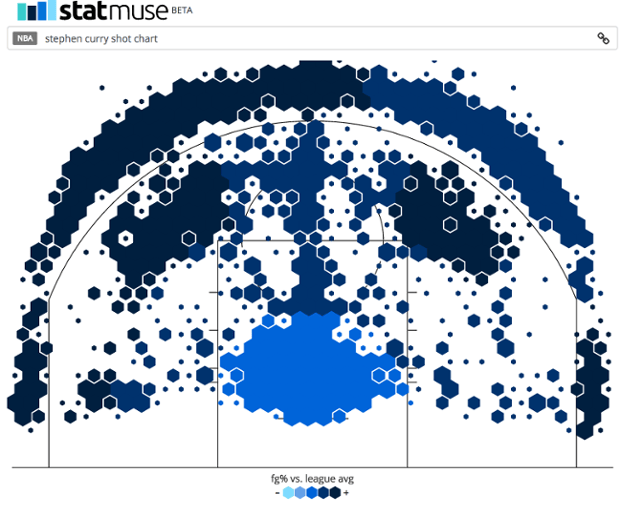
For further proof, peek into their shot charts.
Stephen Curry shot chart
Curry’s shot chart indicates proficiency from all spots on the floor. Illustration: StatMuse
James Harden shot chart reflects a disdain for the mid-range jump shot.
Harden’s chart reflects Illustration: Statmuse
Curry is shooting far above league average virtually everywhere on the floor. The only places he isn’t is right around the bucket, where percentages are already high.
So if you seek an abstract, a case to present to your friends, then I offer this: Stephen Curry eclipses James Harden in every relevant offensive statistical category outside of points per game. He makes up for that loss with his passing. He orchestrates the NBA’s superlative offense while aiding the league’s best statistical defense. He is the most exciting player to watch in the NBA, and one of its finest ambassadors. He’s played over 300 fewer minutes than Harden because he’s often controls the first three quarters of the game and allows himself to rest during the fourth. If you think that’s due to Kerr and the Golden State front office’s savvy roster construction, fine; but the offense never reaches this kind of efficiency and dominance without Curry’s presence and direction.
When Kerr was asked about Morey’s hamfisted Harden campaign, the affable coach answered “We have bigger things to worry about.”
Kerr knows he has the league MVP. Now it’s on the voting committee to let Curry hoist the trophy.
* Yes, I ignored Russell Westbrook as an MVP candidate and will continue to do so. No MVP struggles to get his team to the playoffs no matter how many gaudy triple-doubles he has. He’s had a wonderful individual season, but doesn’t come close to affecting his team the way Curry, Harden, Davis or even his injured teammate Kevin Durant does.