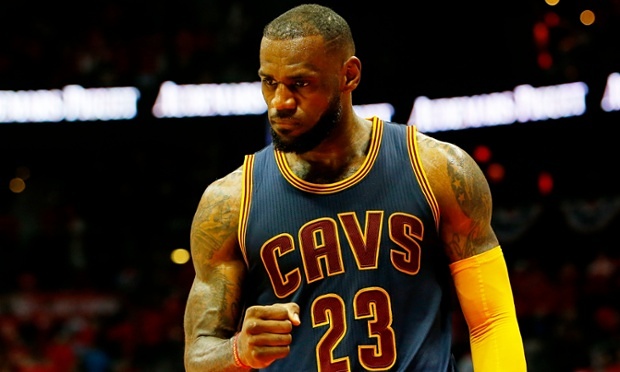
LeBron James was outstanding in the NBA finals but could not lead his team to the championship.
Photograph: Kevin C Cox/Getty Images
LeBron James will saddle up again for the Cleveland Cavaliers after agreeing a two-year contract with the team, according to ESPN. The deal is understood to be worth up to $46.9m, with the second year a player option.
James had not talked to any other teams during free agency, and was never expected to leave his hometown team. Rather, any negotiations on James’s part are to maintain flexible contracts to take advantage of rising salary caps.
The move reaffirms James’s target of winning an NBA championship with the Cavaliers. He came agonizingly close last month, as the Cavs went down 4-2 to the Golden State Warriors in the NBA finals. The last two times James was a free agent he moved teams – from the Cavaliers to Miami Heat in 2010 before a return to Cleveland in 2014.
Another of the Cavaliers’ stars, Kevin Love, says his new five-year, $113.2m contract with the team is “inked and official”. Love said he had met with James before free agency to discuss the team’s future, with forward Tristan Thompson also expected to complete a deal in the coming days. Kevin Love stays at Cleveland Cavaliers citing 'unfinished business' Read more
“I expressed this to LeBron and he’d been through it a couple of times now — I can actually go wherever I want and pick the team I want to play for,” Love said on Thursday.
“But every time I went through the different scenarios I always came out at the same place, and that was to be in Cleveland and try to win championships. I would be able to really help this team win and going forward make a very big impact on this team and on this city, trying to bring a championship or championships.”
The 2015 NBA finals saw the Golden State Warriors clinch their first title in
40 years – and the series was officially confirmed as the highest rated on TV
since 1998, when the Bulls triumphed in Michael Jordan’s final season with
Chicago.
Nearly 20m people, on average, watched the Warriors-Cavaliers series on ABC,
the highest viewership in 17 years, when 29m tuned in to watch Jordan’s Bulls
beat the Utah Jazz in dramatic style.
Cleveland’s LeBron James drives on the Warriors’ Stephen Curry during Tuesday’s Game 6.
Photograph: Ken Blaze/USA Today Sports
Tuesday night’s game, when Golden State won 105-97 in Cleveland to seal a
four-games-to-two series victory, was the most watched Game 6 in ABC’s history,
scoring 23.2m viewers, according to Nielsen.
The previous best in the post-Jordan era came in 2001, when the Shaquille
O’Neal-led LA Lakers defeated the Philadelphia 76ers four games to one, and
18.9m viewers watched. Sunday’s Game 6 at the Quicken Loans Arena was also the
most watched finals game since 2013, when LeBron James notched 37 points in Game
7 against the Spurs to give Miami their second straight championship.
The NBA has failed to replicate the TV ratings it enjoyed in the 1990s, a run
that spiked with Bulls-Suns in 1993 and peaked with Jordan’s Chicago finale in
1998. In that series, broadcast on NBC, the Bulls beat the Jazz in six games.
Jordan hit a 20ft jumper to give Chicago an 87-86 lead with seconds remaining,
and then John Stockton missed a three-pointer to give the Bulls the title. The
game-winner, Jordan’s final shot in a Bulls uniform, is widely acknowledged as
one of the most memorable plays in NBA history.
Television ratings plunged after Jordan retired. Some fans blame the 1998-99
lockout, which wiped out 32 games of the following season and caused many
viewers to switch off. The 1999 Knicks-Spurs series did not rate well on TV.
This season’s finals was also the best rated since it moved to ABC in 2003 –
and the closest the NBA has come to the huge audiences it
enjoyed in the 1980s and 90s.
The Cleveland Cavaliers need to win both remaining games to clinch the NBA
title, but LeBron James is confident his team can do it. Why? Because he’s the
best player in the world.
The Cavs lost 91-104 in Game 5 in Oakland on Sunday night, after the Golden
State Warriors accelerated away from their opponents in the fourth quarter.
Steph Curry scored 37 points and made seven three-pointers to put Golden State
3-2 up in the series – and just one win from a first NBA championship in 40
years.
But James, who produced another scintillating performance at the Oracle
Arena, assisting in 70 of the Cavs’ 91 points, has backed his team to come back
on Tuesday night in Cleveland. “I feel confident because I’m the best player in
the world,” James said on Sunday night. “It’s that simple.”
James, a four-time MVP, had 40 points, 14 rebounds and 11 assists in game
five, becoming only the second player to record a 40-point triple-double in the
championship finals after Jerry West in 1969. James, in this finals series, is
averaging 36.6 points per game.
Cavs coach David Blatt was gushing in his praise of his main man: “LeBron has
been tremendous - [that is] even an understatement for how he’s played in the
series. Under the current set of circumstances, that’s what we’ve got to get,
and he’s bringing it. You don’t see that every day, what he’s doing. You’ve got
to take your hat off to him.”
The Warriors will try to win their first title since 1975 on Tuesday night in
Cleveland at the Quicken Loans Arena. Game 7, if necessary, would be in Oakland
on Friday night. But LeBron said his team weren’t thinking about Friday.
“We’re going home with a game six and we’ve got enough to win it,” James
said. “We protect home, we come [back to Oakland]. We’ll worry about Tuesday
first. But if we protect home like we’re capable of doing, we force a Game
7.”
Golden State coach Steve Kerr had only admiration for his star, Curry: “I
thought from the very beginning when they went small, had their shooters out
there, I thought: this is Steph’s night.
“This is going to be a big one for him because he has all that room. He took
over the game down the stretch and was fantastic.”
“We didn’t turn it over, we were patient,” Warriors shooting guard Klay
Thompson said. “And two words: Stephen Curry.”
The rare MBA in the
NBA, Houston Rockets general manager Daryl Morey not only embraces inflammatory
statements, he offers them up with gusto. The inventor of the revered MIT Sloan
Sports Analytics Conference and driving force behind the new wave of analytical
player evaluation, Morey is a data-driven GM and an engaging Twitter presence
whose vibrant personality has an irreverent flair. He’s candid enough to compare
being an NBA general manager to being a gynecologist (“You never get tired of
it”) and publicly deride prominent media personalities for questioning his
philosophies (see: Barkley, Charles). Last week, perhaps for kicks, he claimed
his Rockets can beat any team in a seven-game series.
So when Morey said “If
James Harden weren’t on our team, we’d be nowhere,” as the primary reason his
hirsute star player should be named Most Valuable Player, it wasn’t on the
greatest hits of Morey-isms. His simplistic reasoning was, however, quite unlike
Daryl Morey. Inherent bias aside, Morey has staked his reputation as one of the
game’s most progressive general managers because of his aggressive roster
reconstructions and acute data crunching. Claiming Harden should win MVP for
being the primary arbiter for his team’s 53 wins wasn’t just trivializing the
ethos of the award, it was an indirect indictment of himself.
Golden State Warriors
guard Stephen Curry is this year’s NBA MVP. The race shouldn’t be close. To
believe that requires a hearty embrace of the analytical whirlwind consuming the
NBA – on another day, we’ll discuss Sam Hinkie’s Philadelphia 76ers – with a
healthy dose of skepticism of how those stats are manipulated. But above all,
anointing Harden the top player ahead of Curry betrays Morey’s beloved
metrics.
The Warriors sit at
63-15 with a 35-2 home record, arguably the most dominant NBA regular season
since the 1996 Chicago Bulls finished 72-10. (To all you weary Lakers fans, go
ahead and make your case.) Along with a stunning average margin of victory of
10.2 points (the Spurs rank second at 6.4), the Warriors entered last weekend
riding a 12-game winning streak with nine of those wins coming by 13 points or
more. Most of those have come with their star players (Curry, Klay Thompson)
resting in the fourth quarter. If the games aren’t won by halftime, they’re won
in the third quarter, and Curry is the engine behind their offensive
brilliance.
If you prefer to keep
your head out of the data sheet and fixed on the television, Curry offers plenty
of MVP credentials. He bombs threes from across the Bay, his dribbling skills
appear to be honed from sorcery, and his no-look passes recall the likes Isiah
Thomas and Magic Johnson. He’s Wayne Gretzky without the skates. I’d link to his
highlights, but the YouTube rabbit hole that awaits would keep you from
finishing the article.
Take this humiliation
of Los Angeles Clippers’ star Chris Paul on Monday night.
Stephen Curry and the clip that launched a
thousand memes.
Even Paul was
impressed enough to post one of the resulting memes on his own Instagram.
Tune into any Warriors
game in the first half and notice opposing defenses try to surround Curry at the
top of the perimeter, only to leave his teammates open in the corner, on the
elbow of the key or in the post. His versatility has helped unlock career-best
seasons from budding stars like Thompson, now one of the NBA’s most feared
offensive threats, and journeymen like Marresse Speights, who two years ago was
unceremoniously released by a Cleveland team that finished 24-58. When Curry has
the ball, they have a better chance to score. And he’s already the most feared
shooter in the NBA. Curry’s spindly constitution and lateral agility keep
defenses permanently on their heels. If they lunge, he’ll bolt by them for a
close-range shot. If they sag off, he’ll knock down a three-pointer. Not since
Steve Nash’s MVP seasons in Phoenix has a point guard helmed an offense with
such fluidity, and more importantly, speed.
Curry
is the real MVP. Photograph: AP
Here’s where the
argument gets a bit stat-heavy. Be patient. We’ll make it through together.
The Warriors average
slightly over 100 possessions per game, the quickest pace in the NBA. Logically,
that’s a risky gambit. More possessions offer more opportunities for points as
well as turnovers. Under Curry’s direction (predominantly), the Warriors are
averaging 19.8 assists per game (tops in the NBA) against 13 turnovers, a
staggeringly good ratio eclipsed only by the Clippers, whose offense is guided
by an eight-time All-Star in Paul. Curry himself is averaging 7.7 per game while
reducing his turnover percentage (turnovers per 100 plays) by almost two per
game from last season. Thus, Curry is not only distributing the ball to players
with a high likelihood of scoring, he’s protecting it better than he has in his
career.
Perhaps most shocking
is that Curry, sometimes criticized as a weak defender, is a key part of a unit
that leads the NBA in defensive rating (measured by points allowed per 100
possessions). Lest you think that’s due to Golden State’s burly interior
defenders, the perimeter defenders are holding opponents to 33.6% from
three-point range, good for fifth in the NBA. Curry isn’t a defensive liability.
And if he still is, then coach Steve Kerr has minimized opponents’ chances to
exploit him.
Harden, the only
reasonable challenger* to Curry in the MVP race – the Pelicans’ Anthony Davis
would be another if not for a midseason injury – has compiled an outstanding
season with 10 40-point games, markedly improved defense, decreased turnovers
and countless clutch baskets. His dizzying crossover dribble and step-back
jumper have established him as one of the game’s finest individual scorers, and
his notoriously lazy defense appears to be a bygone criticism, with Houston a
top-five team in defensive efficiency. His true shooting percentage (a measure
of efficiency that calculates 2-point shots, 3-point shots and free throws) sits
at 60.7, his offensive rating (an estimate of how many points the player
produces per 100 possessions) sits at 118.5, and his team has won 53 games.
These are MVP credentials.
Curry ranks better
Harden in all of those categories and more.
For further proof,
peek into their shot charts.
Curry’s shot chart indicates proficiency from all spots
on the floor. Illustration: StatMuse
Harden’s chart reflects Illustration: Statmuse
Curry is shooting far
above league average virtually everywhere on the floor. The only places he isn’t
is right around the bucket, where percentages are already high.
So if you seek an
abstract, a case to present to your friends, then I offer this: Stephen Curry
eclipses James Harden in every relevant offensive statistical category outside
of points per game. He makes up for that loss with his passing. He orchestrates
the NBA’s superlative offense while aiding the league’s best statistical
defense. He is the most exciting player to watch in the NBA, and one of its
finest ambassadors. He’s played over 300 fewer minutes than Harden because he’s
often controls the first three quarters of the game and allows himself to rest
during the fourth. If you think that’s due to Kerr and the Golden State front
office’s savvy roster construction, fine; but the offense never reaches this
kind of efficiency and dominance without Curry’s presence and direction.
When Kerr was asked
about Morey’s hamfisted Harden campaign, the affable coach answered “We have
bigger things to worry about.”
Kerr knows he has the
league MVP. Now it’s on the voting committee to let Curry hoist the trophy.
* Yes, I ignored
Russell Westbrook as an MVP candidate and will continue to do so. No MVP
struggles to get his team to the playoffs no matter how many gaudy
triple-doubles he has. He’s had a wonderful individual season, but doesn’t come
close to affecting his team the way Curry, Harden, Davis or even his injured
teammate Kevin Durant does.
It was a warm Saturday
afternoon, Match of the Day, May 1973. A huge crowd had packed into the Sydney
Cricket Ground to see South Sydney Rabbitohs against St George.
A titanic battle
between two great rivals saw the scores locked at 11-11, and with just three
minutes remaining South Sydney were granted a penalty on the halfway line. Eric
Simms, arguably rugby league’s greatest goal-kicker, couldn’t make the distance.
Rabbitohs captain Bob McCarthy took a gamble and threw the ball to the 21-year-
old rookie Claude Williams.
A strapping young
Wiradjuri Aboriginal man with a smile as broad as his shoulders, a shock of wavy
black hair and a Zapata moustache, Williams was a surprise inclusion in the
starting line-up. According to the match report in the Sydney Morning Herald, he
was “hardly sighted in general play”, but Williams nonchalantly caught
McCarthy’s pass and slowly fashioned a kicking mound out of the turf.
“The crowd were
getting impatient, but I needed to build it high to make the distance,”
remembers Williams. “I wasn’t nervous, because it was so far out nobody expected
me to make it.”
How the sports pages
reacted to that kick.Photograph: Claude Williams
After a long run-up,
Williams put his right boot firmly through the ball and sent it sailing
majestically between the uprights to a rapturous roar from the Rabbitohs
supporters. The first man to embrace him was Simms, and in the dressing room
after the match, Channel Nine television personality and fanatical Rabbitohs fan
Don Lane grabbed him by the collar, drew him close and planted a kiss firmly on
his forehead. “Thank God Bobby gave Claude the kick,” said Simms, “I never would
have made it that far.” Williams was asked to appear on rugby league’s weekly
television show. A star, it seemed, was in the making.
“I never went on that
program,” says Williams. For all the accolades he received in the press after
the winning kick, his memory is of returning to work on the Monday. A storeman
at a cosmetics company in Surry Hills, he was feted by his colleagues. “I walked
in and all of them came round to our section and said ‘good onya Claude,
fantastic kick’. You know for me, it was no big deal. I was never one to blow my
own trumpet or act the poser. I had confidence in myself, but I didn’t talk
myself up.”
It’s characteristic of
Williams that he skipped the scheduled television appearance to spend the day
with his mate and two girls on a harbour ferry. “You know, it was in the paper
about me scoring that kick,” he says. “My mate was telling the girls that I was
the bloke that scored the kick. I was just 21, a shy kind of kid, in those days
I wasn’t a talker. I wasn’t confident speaking to the media – in those days
there was no media training. I never had that experience and confidence to get
in front of a TV camera and talk about it. There weren’t too many players who
were media savvy in those days.”
Self-promoter he was
not, but from a young age Claude Williams was destined to be a sportsman. At 15
he was opening both the bowling and the batting for the Sydney Cricket Club in
the AW Green Shield competition. Indeed several years before that kick for the
Rabbitohs, he made his debut at the SCG in a City vs Country representative
cricket match. “It was like hallowed turf,” he remembers fondly.
The Sydney Cricket Ground - where it all started
for Williams.Photograph: Claude
Williams
Rugby league, however,
became the focus after Williams helped Zetland win the 1969 C grade grand final
against La Perouse at Redfern Oval. As Williams tells it, the legendary
Rabbitohs captain John Sattler picked him out of the pack, silencing the rowdy
dressing room as he entered to congratulate them on their victory.
“I was sitting in the
corner of the change room, and he came over, put his hand over and said, ‘Hi,
I’m John Sattler’. I was a really quiet kid in those days, you know I was very
reserved and introverted. I said ‘Yes, how are you John, I’m Claude’. He said,
‘Yes, I know who you are Claude, I just watched you play and I was very
impressed with your game. I’m here to ask you if you’d like to play senior grade
next year.’.
Williams’s father
encouraged his son to seize the opportunity. “I was in two minds,” he says. “I
was only 16, and it wasn’t as if I lacked confidence, but I thought I wouldn’t
mind playing another year or two and mature a bit. But Dad said, ‘No I think you
should give it a go.’” His father, of course, was the iconic country and western
singer Claude ‘Candy’ Williams. Mates with the great Aboriginal leaders Chika
Dixon and Charlie Perkins and a regular performer at the Foundation for
Aboriginal Affairs, Candy was a star in his own right, yet he could be found at
all of his son’s matches, no matter the level.
It was the kind of
support that Williams needed, but didn’t get from rugby league. In one Rabbitohs
game, when he lined up against a childhood hero, Williams was shocked by what he
heard. “I was on the wing, I got the ball and as I ran inside he yelled out
‘kill that black cunt!’ I thought, fuck! It sort of threw me. It stung me. It
really hurt inside – it affected me that. When he got the ball I’d chase him to
try and get a square-up, but he was quick and I never got the chance.”
Williams only played a
handful of top-flight rugby league matches, but he refuses to dwell on the
possibilities. He freely admits that Clive Churchill’s Rabbitohs – “that
fantastic team” he calls them – was near impossible to break into as a young
player.
“The career depends on
what you produce on the field,” he says firmly when I ask him whether he lacked
the requisite streak of self-interest. And the racism? “It was just as bad for
the Chinese,” he says. “They were called chinks, the Europeans – the Italians
and the Greeks – they were called wogs and dagoes, so they copped it just as
much.”
Williams leads celebrations on Souths’ bench,
flanked by Clive Churchill and John Sattler. Photograph: Claude Williams
Williams walked away
from rugby league to pursue his great love – basketball. From a multitalented
family (his first cousin Harry was the first Indigenous man to represent the
Socceroos at a World Cup in 1974), throughout his short career at the Rabbitohs
he had moonlighted as a guard with Eastern Suburbs in Sydney’s premier
basketball competition. Monday and Friday basketball training bookended
Wednesday night games, while Tuesdays, Thursdays and weekends were dedicated to
rugby league. “My whole week – basically six days – was taken up with basketball
or rugby league,” he says. All, of course, while drawing his wage on the factory
floor.
In 1974 and 1975
Williams was selected for the New South Wales basketball team in the Nationals,
but his contract with South Sydney prevented him from participating. “I wasn’t
getting paid much, but I was still contracted,” he explains. “For two years I
said, ‘I can’t go, I’m sorry.’”
Walking away from
rugby league to pursue a career in basketball might have seemed like a step
backwards, but it connected him to something far bigger than sport.
Williams felt more at
home on the basketball court than on the football field.Photograph: Claude Williams
The 1970s was a time
of enormous change in the consciousness of Indigenous people. A group of young
black radicals including Gary Foley, Bruce McGuiness, Paul Coe, Bob Maza, Denis
Walker and Bobbi Sykes were at the crest of a new Black Power movement in
Brisbane, Redfern and Fitzroy. Black empowerment was the call,
self-determination was the aim. Williams was never involved in the politics –
“mate, I was too busy playing sport,” he grins – however just as the nascent
Aboriginal Black Power movement looked to the United States for inspiration and
fraternal support, Williams was influenced by a trip to the west coast of
America.
Basketball took him
places where rugby league couldn’t. In 1977 Williams travelled to America,
Canada and Hawaii with the NSW Basketball team. The bumper crowds, marching
bands, orchestras and cheerleaders of college basketball were a shock to the
Australians, but for Williams the off-court action was just as enlightening.
“They thought we were
English,” he says. “I found the African Americans knew a little bit about
Aboriginal Australia, and when I spoke to them it was like an instant bond. Like
we’d come from the same footsteps – there was an instant respect. It was the
same with the African American players in the NBL, I used to connect with them
stronger than most. They had a higher respect for me as an Aboriginal man.”
Returning home,
Williams landed a job as a clerk with the council and played with the City of
Sydney Astronauts in the early seasons of the National Basketball League, which
was launched in 1979. The bulging lump that protrudes from the knuckle on his
right hand is a war scar testament to his rough and ready style of play. By
1983, the Astronauts became the Sydney SuperSonics, and the legendary American
import Owen Wells signed on as player-coach. Wells fired a rocket up Australian
basketball, and with Williams in the team, lead the SuperSonics to a
record-breaking 16-game winning streak.
Williams, the centre of attention on the Sydney
SuperSonics’ bench.Photograph: Claude
Williams
“We connected over
music,” says Williams. “He was into a lot of jazz – he was different, most of
the African Americans who came out were all r&b. In the dressing rooms it
was always ghetto blasters with the latest r&b and soul music, but not many
were into jazz. Owen was highly intelligent, highly educated and knew his music.
He was very stylish and classy – an inspiration to his team-mates.”
As Williams recounts
memories of his old friend, it’s hard to ignore the influence. The wild hair of
Williams’s youth has given way to a slicker short-back-and-sides, and his
handlebar moustache has been trimmed down to a thin pencil above his upper lip.
A comb is always handy in his bag. Gold jewellery adorns his fingers and neck,
several rubber bracelets with the words “Deadly Vibe” wrap around each wrist,
and he’s wearing a Miles Davis t-shirt. He’s equally comfortable discussing the
finer points of Betty Davis, The Undisputed Truth or The Isley Brothers at Lazy
Bones Lounge in Marrickville as he is playing snooker in local competitions.
In 1987, Williams
became Wells’s assistant coach and as they travelled around the country they
roomed together, sharing basketball tactics and listening to Blue Train by John
Coltrane. Their friendship was an intellectual bond. After 101 NBL games,
Williams was ready for a new challenge.
The composition of
Sydney basketball was set to change for a third time within a decade. In October
1987, the owner of the SuperSonics, Mike Wrublewski, formed a new franchise
called the Sydney Kings. A merger of the SuperSonics and the West Sydney
Westars, the press reported the Kings would be “the saviour of basketball in
this city”.
A portrait of Claude Williams, taken at the
National Centre of Indigenous Excellence in March, 2015.Photograph: Phat Ngo for Guardian Australia
Williams was appointed
as head coach, becoming one of just a few Australians to take the reigns of an
NBL team and the first and only Aboriginal basketball coach. Rugby league
commentator and historian Brad Cooke reckons Williams was the second Aboriginal
coach in any elite sport (Arthur Beetson coached Easts in rugby league in the
1970s).
Williams played the
role of front-man, commenting in 1987 that the creation of the Sydney Kings was
“a positive step that we are united”. The reality, however, was rather
different. The “one team, one city” concept had been advocated for years by
Wrublewski, but it was only after mounting financial losses that West Sydney
agreed to the idea. The rivalry inevitably seeped from board level into the
dressing room. In one infamous incident, team-mates Damien Keogh and Marc Ridlen
– formerly of the Westars and SuperSonics respectively – almost came to blows in
a match against Illawarra Hawks.
If coaching is all
about managing delicate egos, Williams’s job to funnel the players of two teams
into one entity was a crash course in diplomacy. “The better players would be
used to playing lots of minutes,” he says. “I was a first year head coach, I had
all the strategies in place and I knew exactly what I wanted. It wasn’t
particularly the team I wanted – I didn’t have carte blanche. There was a
compromise between the two clubs with the selection of players. I knew it would
take time for the chemistry to develop.”
As the season wore on
and results failed to go their way, the Sydney Morning Heraldbasketball journalist Ian Cockerill concluded: “Although the Kings have
assembled a squad of brilliant individuals this year they have failed to congeal
as a team and appear in danger of missing the play-offs.”
Miss the finals they
did, and by season’s end Williams had accepted an offer from Newcastle Falcons.
Wrublewski was notorious for his hands-on, passionate approach, but Williams was
continually frustrated by the intrusion of board members in the coaching of the
team. His two seasons at Newcastle, however, weren’t much better. “Like a lot of
coaches I personally found it difficult to communicate with board members who
are businessmen, not basketballers,” he says.
A little over two
decades on since his last involvement in top-flight sport, it seems Claude
Williams is remembered in flashes and snippets. Few of the basketball and rugby
league scribes of the day recall the man, although they all remember the name.
There’s bits and pieces on the Sydney Kings website, and of course a few
mentions on basketball and rugby league websites.
‘South Sydney’s lively young utility back’,
according to this newspaper report, with Rabbitohs coach Clive Churchill.
Photograph: Claude Williams
One of these sites,
Rebel Rabbitohs, is particularly revealing. ABC journalist Andrew Denton – a man
who led the charge for South Sydney to be returned to the NRL in 2001 – tells
his favourite childhood memory of listening to the legendary rugby league radio
commentator Frank Hyde calling Williams’s goal-kick in 1973. “A couple of years
ago I saw Andrew on the corner of Oxford and Crown Street,” says Williams. “I
was going to go up to him and introduce myself, but he approached me and
mentioned the kick. We had a good chat.”
Like many Indigenous
athletes of yore, Williams is best remembered among his own people – recognised
as one of the “Black Diamonds” in the Aboriginal and Torres Strait Islander
Sports Hall of Fame. He comes from a long line of luminaries from the Wiradjuri
nation, including Linda Burney, Paul Coe, Mum Shirl, Anita Heiss, Stan Grant,
Wally Carr, Evonne Goolagong-Cawley and David Peachey.
Yet Cooke, who used to
run a boxing program with Williams on Koori Radio, reckons he’s been
under-utilised by the community. “My best memory of Claude, apart from being the
legend and a Black Diamond, was from a boxing trip to Vegas in 2009,” he says.
“He went from being an “Uncle” and a godlike figure to getting excited for
interviews with legends of boxing like [Muhammad Ali’s biographer] Thomas Hauser
and Roberto Duran. He talked to Roberto about his fight against the Aboriginal
boxer Hector Thompson.”
For the best part of a
decade Williams travelled around Australia running basketball programs for
Aboriginal kids with Vibe Australia, and he helped Aboriginal people find work
during the 2000 Sydney Olympics as an Indigenous liaison officer at Stadium
Australia.
When there’s an event
in Sydney’s Aboriginal community, you’ll find Williams there. In 2006, while he
was running the boxing radio program, a plaque was unveiled in Glebe to
commemorate the great Aboriginal middleweight boxer Dave Sands. The plaque, said
Williams in his speech as MC, “is a symbol of our commitment to remember and
celebrate the great heroes in our community”. In February, he addressed the
crowd at Redfern’s National Centre of Indigenous Excellence to mark the
anniversary of the Australian Government’s apology to the Stolen Generation.
The National Centre of
Indigenous Excellence turned five this month, and “Uncle Claude” works in the
after-school program and the Deadly Young leaders program. He was born just up
the road in Camperdown, and you’ll find him every other week in his old stomping
ground with his good mate Tony Mundine. Tony, of course, is the father of one of
Australia’s greatest sportsmen, Anthony, a man who has also traversed two
different sports with great success. There are links and deep roots in these
friendships – shared memories, shared histories and shared goals. “I want to
give back to these kids and this community,” says Williams. “It’s a
challenge.”
Basketball remains a
burning passion, and Williams hopes to return to coaching sooner rather than
later. Like a tactics junkie needing his fix, to this day he’ll watch college
basketball over NBA, where the coaching and strategy is more pronounced. “It’s
the greatest game I’ve ever played,” he says. “Basketball is an intelligent game
– there’s individual skill and the technical side.”
For a man that has
been at the top of his game in rugby league, basketball and junior cricket,
incredibly there remains one lingering regret. At 15, while he was at Cleveland
Street High School, he was scouted by the NSW Lawn Tennis Association to join
their elite program at White City in Paddington. “I was excited, and to be
honest, in my heart, that’s what I wanted,” he says.
Cost was the barrier
to entry, and the exorbitant fee was out of the family budget. His dream was
dashed. “I’d have to say if there’s any regrets, that would be the biggest ever
in my life, that I wasn’t able to play tennis,” says Williams. “I honestly think
I wouldn’t have played cricket, rugby league or basketball. I believed I was the
best. I still know to this day that if I could’ve followed that path I could’ve
gone all the way.”